
Assessment framework · Finance & Risk
BCBS 239 risk data aggregation assessment
BCBS 239 sets the Basel Committee's principles for effective risk-data aggregation and risk reporting, applied to global and domestic systemically important banks.
Rate risk-data aggregation and reporting capability against BCBS 239.
What it covers
Inside the BCBS 239 Risk Data Aggregation assessment.
Celeredge gauges risk-data aggregation and reporting capability against the BCBS 239 principles of governance, accuracy, completeness, timeliness and adaptability, and ranks the gaps.
- Scored on BCBS 239 Risk Data Aggregation's own scale, not a generic rubric
- Every score traceable to the client's own evidence
- Gaps ranked by severity, ready to become the plan
- A board-ready slide deck and detailed report, generated automatically
How it works
From the client's documents to a board-ready deck.
1 · Evidence in
Upload the client's documents: policies, reports, data. An AI interviewer asks targeted follow-ups to fill anything missing.
2 · Scored on the standard
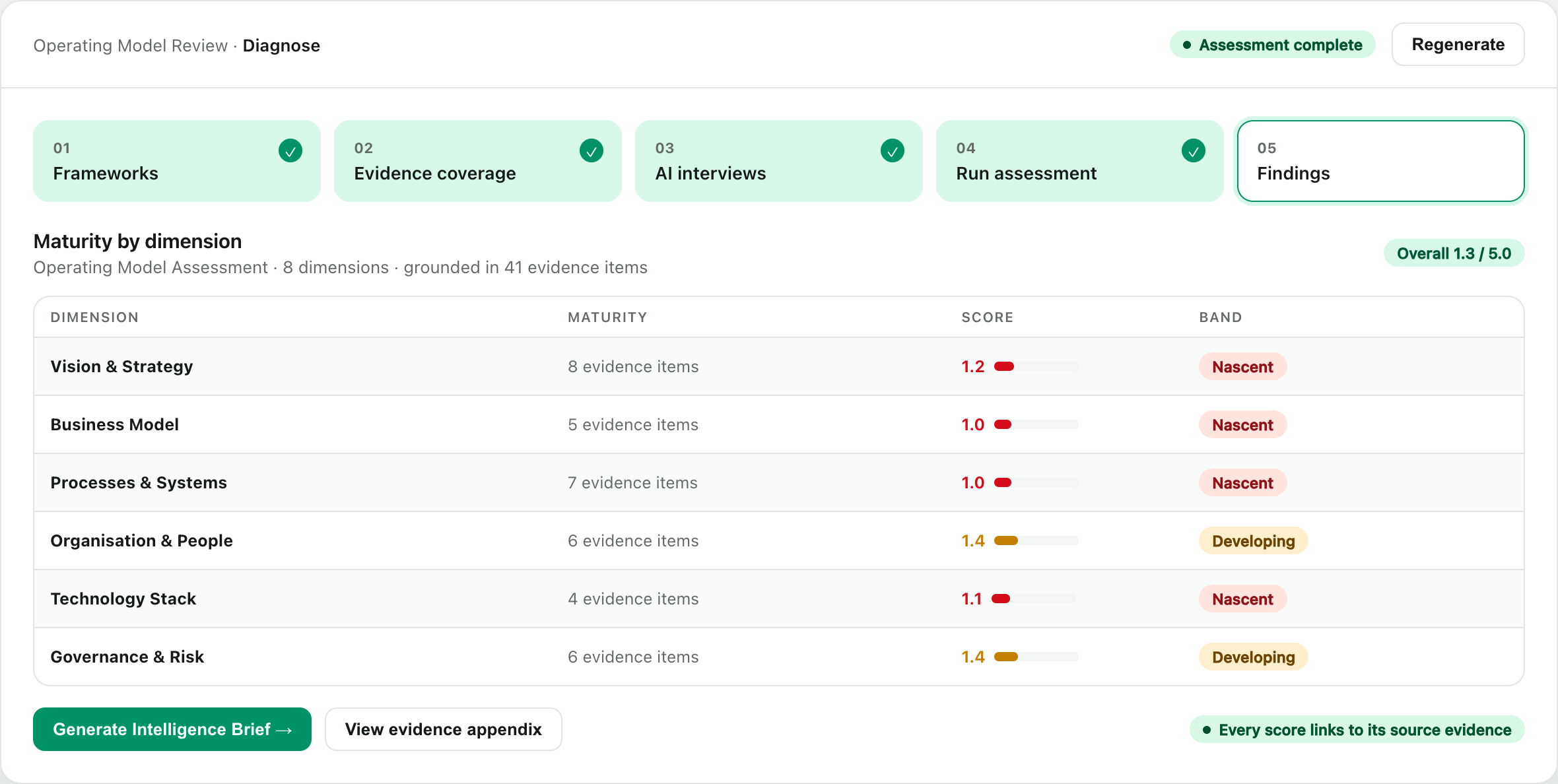
Every dimension is scored on the framework's own scale, with each score traceable to the evidence behind it, and gaps ranked by severity.
3 · Board-ready out
A board-ready slide deck and HTML report are generated automatically: executive summary, maturity landscape and a sequenced plan.
Questions
BCBS 239 Risk Data Aggregation assessment FAQ
What is BCBS 239 Risk Data Aggregation?
BCBS 239 sets the Basel Committee's principles for effective risk-data aggregation and risk reporting, applied to global and domestic systemically important banks.
What does a Celeredge BCBS 239 Risk Data Aggregation assessment deliver?
An evidence-based maturity or readiness assessment scored on BCBS 239 Risk Data Aggregation's own scale, with gaps ranked by severity and an auto-generated, board-ready slide deck and detailed report. Every score is traceable to the evidence behind it.
How does the BCBS 239 Risk Data Aggregation assessment work?
Clients upload their own evidence: policies, reports and data. An AI interviewer asks targeted follow-ups to fill anything missing, the platform scores against the framework, ranks the gaps, and generates the deliverables.
More Finance & Risk frameworks
Related assessments
Finance Function & FP&A Maturity
Score the finance function and FP&A across planning, reporting and partnering.
Enterprise Risk Management (COSO ERM)
Assess enterprise risk management against the COSO ERM framework.
Operational Resilience (EU DORA)
Gauge digital operational resilience readiness against EU DORA.
FCA Operational Resilience (PS21/3)
Map important business services and impact tolerances to FCA PS21/3.
FCA Consumer Duty
Assess Consumer Duty outcomes: products, price and value, understanding and support.
Senior Managers & Certification Regime (SM&CR)
Check SM&CR readiness across responsibilities, certification and conduct rules.
UK Corporate Governance Code (FRC)
Evidence compliance with the FRC UK Corporate Governance Code.
AML & Financial Crime
Assess anti-money-laundering and financial-crime controls against regulatory expectations.
MiFID II
Check investment-firm conduct and reporting readiness against MiFID II.
PSD2 & Open Banking
Assess payment-services and open-banking compliance against PSD2.
Solvency II
Assess insurer capital, governance and reporting readiness against Solvency II.
IFRS 9 / IFRS 17
Check accounting readiness for IFRS 9 financial instruments and IFRS 17 insurance contracts.
ISO 37001 / 37301 Anti-Bribery & Compliance
Assess anti-bribery and compliance management systems against ISO 37001 and ISO 37301.
See the BCBS 239 Risk Data Aggregation assessment on real data.
We'll run BCBS 239 Risk Data Aggregation live and score it from a client's own documents.