
Assessment framework · Cybersecurity
NIST CSF 2.0 maturity assessment
The NIST Cybersecurity Framework (CSF) 2.0 organises cybersecurity outcomes into six functions: Govern, Identify, Protect, Detect, Respond and Recover. It is a voluntary, outcome-based framework used to assess and improve security posture.
Score maturity across all six CSF 2.0 functions, evidenced from the client's own controls.
What it covers
Inside the NIST CSF 2.0 assessment.
Celeredge scores maturity across all six CSF 2.0 functions and their categories, evidenced from the client's own controls, and produces a target-state roadmap ranked by risk.
- Scored on NIST CSF 2.0's own scale, not a generic rubric
- Every score traceable to the client's own evidence
- Gaps ranked by severity, ready to become the plan
- A board-ready slide deck and detailed report, generated automatically
How it works
From the client's documents to a board-ready deck.
1 · Evidence in
Upload the client's documents: policies, reports, data. An AI interviewer asks targeted follow-ups to fill anything missing.
2 · Scored on the standard
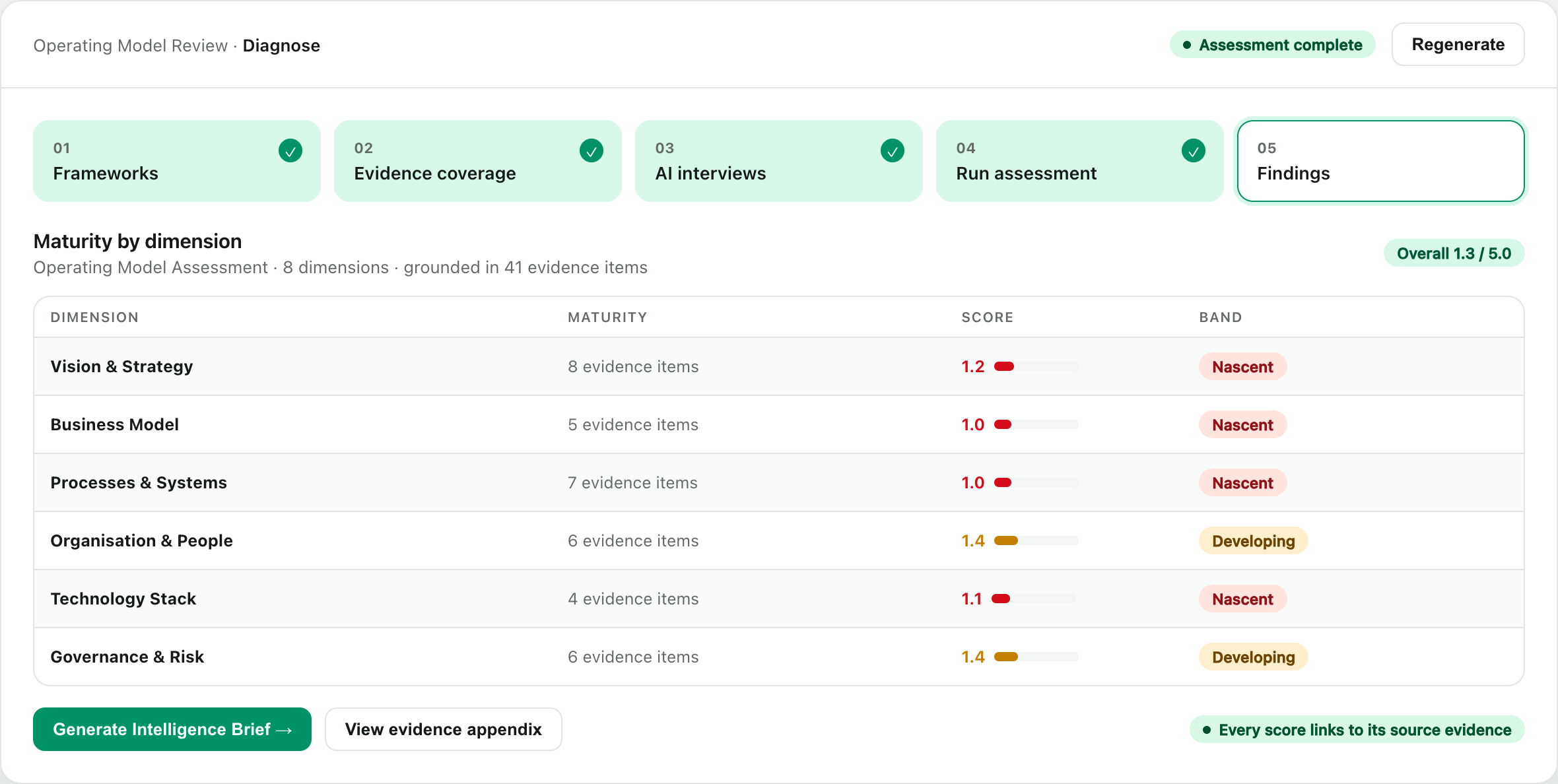
Every dimension is scored on the framework's own scale, with each score traceable to the evidence behind it, and gaps ranked by severity.
3 · Board-ready out
A board-ready slide deck and HTML report are generated automatically: executive summary, maturity landscape and a sequenced plan.
Questions
NIST CSF 2.0 assessment FAQ
What is NIST CSF 2.0?
The NIST Cybersecurity Framework (CSF) 2.0 organises cybersecurity outcomes into six functions: Govern, Identify, Protect, Detect, Respond and Recover. It is a voluntary, outcome-based framework used to assess and improve security posture.
What does a Celeredge NIST CSF 2.0 assessment deliver?
An evidence-based maturity or readiness assessment scored on NIST CSF 2.0's own scale, with gaps ranked by severity and an auto-generated, board-ready slide deck and detailed report. Every score is traceable to the evidence behind it.
How does the NIST CSF 2.0 assessment work?
Clients upload their own evidence: policies, reports and data. An AI interviewer asks targeted follow-ups to fill anything missing, the platform scores against the framework, ranks the gaps, and generates the deliverables.
More Cybersecurity frameworks
Related assessments
SOC 2 (Trust Services Criteria)
Run a SOC 2 gap assessment across the five Trust Services Criteria before the audit.
ISO/IEC 27001 ISMS Readiness
Gauge ISMS readiness against the Annex A controls before committing to certification.
PCI DSS v4.0
Assess cardholder-data security against the PCI DSS v4.0 requirements and SAQ scope.
CIS Controls v8
Benchmark the 18 CIS Controls and implementation groups against real evidence.
Zero Trust (CISA ZTMM)
Rate zero-trust maturity across the five CISA pillars and the gaps to close first.
Cyber Essentials (NCSC)
Check readiness against the five NCSC Cyber Essentials control themes before assessment.
NCSC Cyber Assessment Framework (CAF)
Assess against the 14 CAF principles for NIS-regulated and critical services.
NHS Data Security & Protection Toolkit (DSPT)
Evidence the NHS DSPT standards for health and care organizations.
ISO/IEC 27701 Privacy Information Management
Extend an ISMS to privacy and assess PIMS readiness against ISO 27701.
ISO 22301 Business Continuity
Gauge business-continuity management-system readiness against ISO 22301.
OWASP SAMM
Benchmark software-assurance maturity across the OWASP SAMM business functions.
Third-Party & Supply-Chain Risk
Assess vendor and supply-chain cyber risk and due-diligence maturity.
See the NIST CSF 2.0 assessment on real data.
We'll run NIST CSF 2.0 live and score it from a client's own documents.